
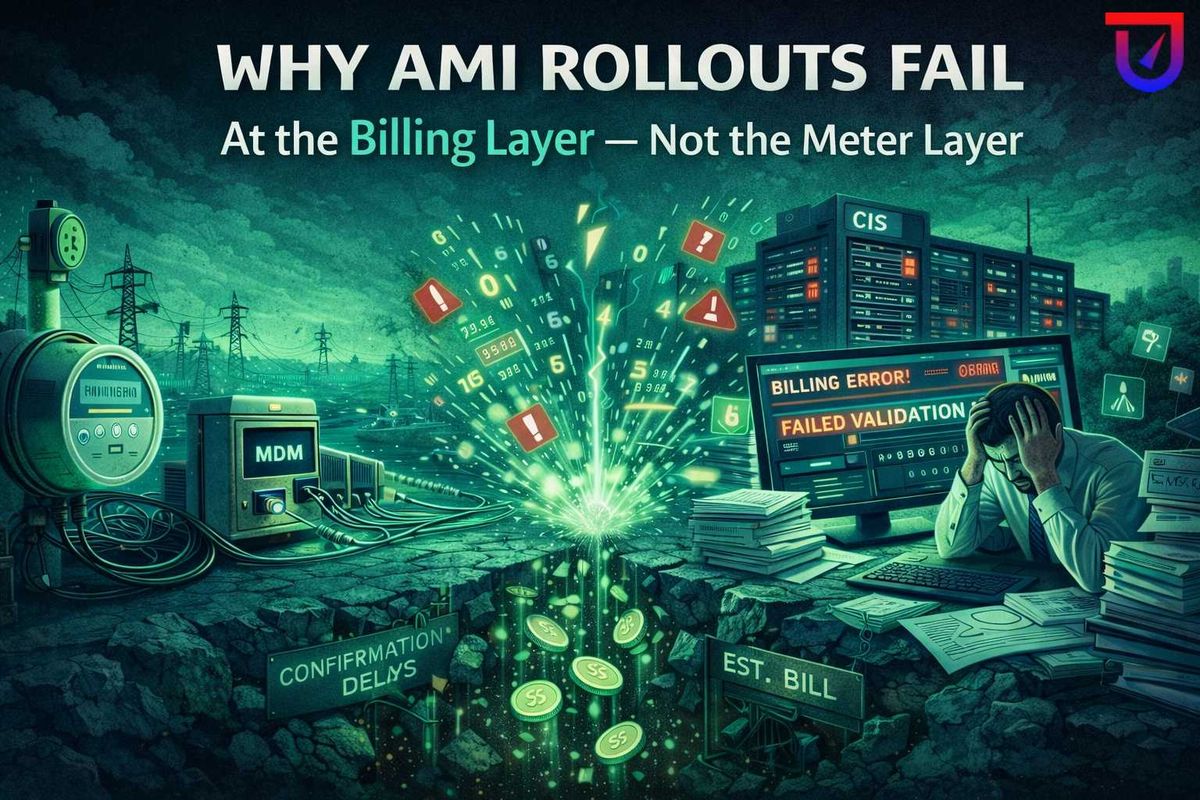
When utilities invest in Advanced Metering Infrastructure (AMI), the focus is almost always on the hardware.
Smart meters. Communication networks. Head-end systems. Field deployment logistics.
The assumption is simple: once smart meters are installed, operational efficiency and revenue accuracy will automatically improve.
But here’s the reality many utilities quietly experience:
AMI projects rarely fail because of the meters.They struggle because the billing system cannot handle the data.
The Data Explosion Problem
Traditional meters generate one read per month.
AMI meters generate:
- 15-minute interval data
- 30-minute interval data
- Hourly reads
- Event notifications
- Outage alerts
- Tamper flags
Instead of 12 reads per year per customer, utilities suddenly receive 8,760+ data points annually — sometimes much more.
If the CIS (Customer Information System) was built for monthly scalar reads, it simply cannot ingest, validate, and apply this volume correctly without strain.
What happens next?
- Billing delays
- Failed validations
- Estimated bills despite having actual interval data
- Manual workarounds
The problem is not AMI. It is billing architecture.
The MDM–CIS Disconnect
Most AMI projects introduce a Meter Data Management (MDM) system between meters and billing.
The flow becomes:
Meter → Head-End → MDM → CIS
On paper, this seems clean.
In practice, integration logic becomes fragile:
- Validation rules mismatch
- Time-of-use mapping errors
- Demand calculation misalignment
- Data latency issues
If MDM calculates demand differently than the CIS expects, billing inaccuracies begin immediately.
AMI success depends less on meter accuracy and more on synchronized billing logic.
Time-of-Use and Rate Complexity
AMI enables sophisticated rate design:
- Time-of-use (TOU)
- Critical peak pricing
- Dynamic pricing pilots
- EV-specific tariffs
But sophisticated rates require advanced billing engines.
A TOU rate is not just “peak vs off-peak.” It often involves:
- Seasonal variations
- Holiday exceptions
- Weekend definitions
- Demand components
- Riders layered on top
Legacy CIS systems often require heavy customization to support this. Each customization increases risk.
When billing errors occur under TOU structures, customer complaints rise quickly — because the bills are harder to understand.
The Operational Impact Nobody Plans For
Utilities often underestimate the internal stress AMI places on billing operations:
- Exception queues multiply
- Call center volumes increase
- Billing analysts spend more time validating data
- IT teams patch integration issues
Instead of operational efficiency, AMI can temporarily create operational chaos.
Unless the billing system is modernized alongside the meter rollout.
AMI Is a Data Strategy — Not a Hardware Project
Successful AMI implementations treat billing as a core pillar from day one.
They ask:
- Can our CIS handle interval billing natively?
- Is our rate engine configurable or hard-coded?
- Can we simulate bills before rate deployment?
- Do we have automated validation workflows?
AMI delivers its real value only when:
- Bills reflect accurate interval consumption
- Customers see transparent usage breakdowns
- TOU pricing is applied without manual intervention
- Revenue assurance controls are automated
The Hard Truth
Utilities that upgrade meters without upgrading billing systems often discover a difficult lesson:
Smart meters do not fix billing inefficiencies.
They expose them.
AMI is transformational — but only if the billing layer is ready to process, validate, rate, and explain the data it receives.
Otherwise, the smartest meter in the world still produces a confused bill.

Written By
Anand Kulkarni
15+ years experience in scalable cloud architecture and enterprise SaaS. Leading platform roadmap and security strategy.
