
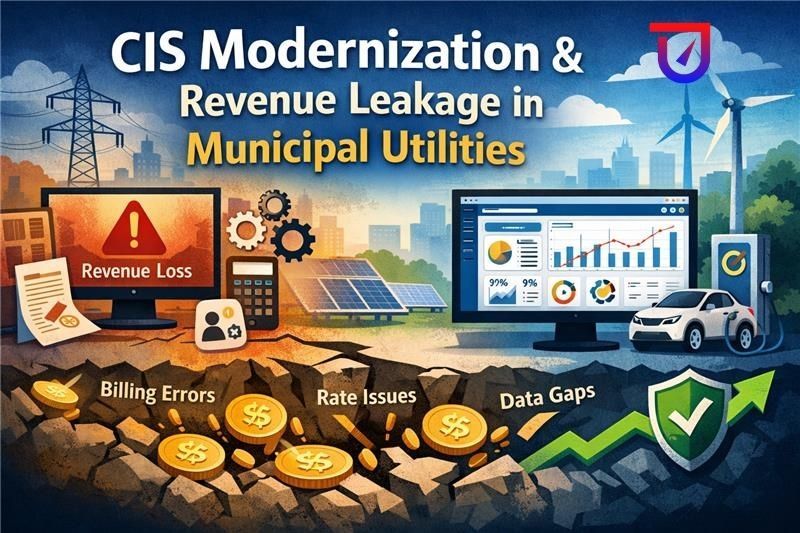
For many mid-sized municipal utilities, revenue leakage doesn’t happen because of theft. It happens quietly — inside the billing system.
Most public power utilities serving 20,000 to 150,000 customers are running legacy CIS platforms that were implemented 15–25 years ago. These systems were designed for stable rate structures, predictable consumption, and manual processes. That world no longer exists.
Today’s utility environment includes distributed energy resources, time-of-use rates, complex tax jurisdictions, EV tariffs, and regulatory scrutiny. When the billing core isn’t built for this complexity, revenue gaps start forming.
Where Revenue Leakage Actually Happens
Revenue leakage in municipal utilities typically shows up in five areas:
Incorrect rate application after rate revisions
Manual overrides during exception handling
Improper customer class reclassification
Delayed meter-to-bill processing
Incomplete integration between MDM and CIS
These are not dramatic failures. They are small inaccuracies multiplied across thousands of accounts.
For example, when a rate change is configured manually across different billing determinants, even a small configuration oversight can undercharge specific customer segments for months before detection. Most utilities discover these issues only during annual audits — long after recovery becomes politically sensitive.
The Hidden Cost of Manual Billing Exceptions
In many municipal utilities, exception queues are handled manually. An account falls into exception status, an analyst reviews it, makes adjustments, and pushes it forward.
The issue isn’t the exception itself — it’s the lack of systemic controls around why the exception occurred. When root causes are not analyzed, the same billing errors repeat month after month.
A modern CIS provides:
- Automated exception categorization
- Root cause tagging
- Revenue impact tracking
- Automated retry logic
Without these, leakage becomes normalized as “operational noise.”
Data Integrity & Rate Complexity
Municipal utilities often underestimate the impact of rate complexity on billing accuracy.
Block rates, seasonal rates, demand charges, riders, storm recovery surcharges, and renewable adjustments — all layered together — create billing logic that legacy systems struggle to maintain without heavy customization.
When billing logic depends on hard-coded scripts rather than configurable rule engines, every rate case increases risk exposure.
CIS modernization is not about having a prettier interface. It is about:
- Parameterized rate engines
- Version-controlled rate changes
- Automated audit trails
- Revenue simulation before deployment
Regulatory & Public Trust Implications
Municipal utilities operate under public scrutiny. Billing inaccuracies don’t just impact revenue — they impact trust.
When customers question their bills and call volumes spike, the issue quickly escalates to city council discussions. Modern CIS platforms reduce this exposure through:
- Transparent bill breakdowns
- Self-service portals
- Real-time usage access
- Automated validation checks
Modernization as Revenue Protection
CIS modernization should not be framed as IT transformation. It is revenue assurance strategy.
A well-implemented modern billing system typically delivers:
- Reduction in manual adjustments
- Faster billing cycles
- Lower write-offs
- Improved audit readiness
- Increased billing accuracy
For a municipal utility operating on thin margins, even a 1% reduction in revenue leakage can fund major infrastructure improvements.
The real question is not whether modernization is expensive.
The real question is:How much silent revenue loss is already happening — and going unnoticed?

Written By
Sudeep Purohit
13+ years experience with North American utilities. Expert in CIS modernization and meter-to-cash workflows.
